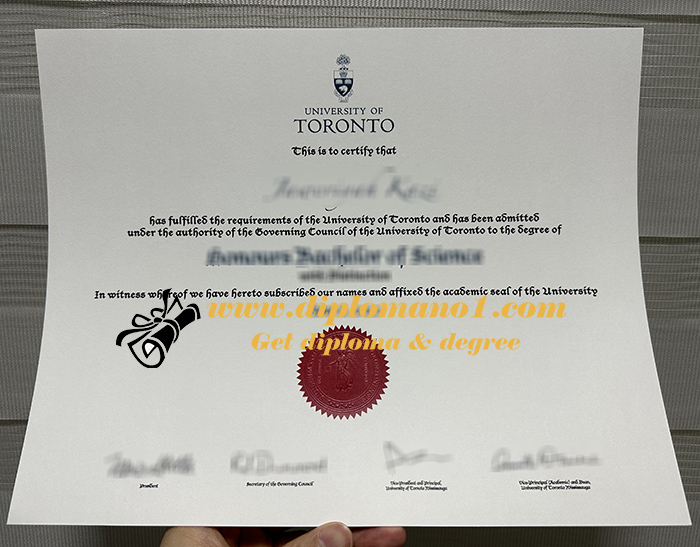
Nestled on the shores of Lake Ontario in Canada lies the University of Toronto (U of T), a world-class institution hailed as “the crown jewel among Canadian universities.” As Canada’s oldest and largest public research university, U of T is renowned not only for its profound historical legacy and outstanding research capabilities but also for its exceptional international recognition, making it an academic destination of choice for students worldwide. For those aspiring to academic excellence and seeking to establish themselves in North America’s top professional circles, a degree from the University of Toronto is more than just a credential—it is a globally recognized passport of value. The reasons to get a University of Toronto diploma certificate.
I. Campus Overview: The Real-Life “Hogwarts”
Founded in 1827 as King’s College, the University of Toronto boasts nearly two centuries of distinguished history. Its main campus, St. George, is located in the heart of downtown Toronto, adjacent to the Ontario Legislative Building and the Royal Ontario Museum. Here, classical Victorian architecture blends seamlessly with modern glass facades, while red-brick archways and Gothic spires stand proudly—making it a key filming location for the Harry Potter series and earning it the affectionate nickname “real-life Hogwarts” among students.
In the 2026 QS World University Rankings, the University of Toronto ranks 32nd globally and remains the top university in Canada. While rankings may fluctuate slightly due to evaluation criteria, U of T consistently ranks within the global top 20 in US News and other rankings that emphasize research impact, solidifying its dominant position in academic reputation and scientific output across North America and beyond. The university comprises three campuses—St. George (UTSG), Mississauga (UTM), and Scarborough (UTSC)—all under unified administration. Degrees awarded by each campus carry identical legal standing and are issued jointly by the University of Toronto.
II. Academic Excellence: A Cradle for Nobel Laureates
The University of Toronto stands at the forefront of academic strength, boasting the highest research funding and citation rates in Canada. In 2024, the Nobel Prize in Physics was awarded to U of T professor Geoffrey Hinton for his pioneering contributions to artificial intelligence and neural networks—an achievement that further cements the university’s leadership in cutting-edge science.
Computer science and artificial intelligence are U of T’s flagship strengths. Backed by leading scholars such as “father of AI” Geoffrey Hinton, the university’s computer science research sits at the global frontier, attracting attention from major technology firms worldwide. Medicine and life sciences are also internationally renowned, with breakthroughs including the discovery of insulin and pioneering work in stem cell research. The university hosts multiple affiliated teaching hospitals, providing abundant resources for medical research and education.
In business, the Rotman School of Management ranks among the most prestigious business schools in North America, particularly celebrated for its finance and business analytics programs. Engineering science, education, psychology, and other disciplines also consistently rank among the world’s best. As a comprehensive research university, U of T has few weak spots, offering over 700 undergraduate programs and more than 200 graduate programs. Unexpected methods to get a University of Guelph diploma online.
III. Degree Value: Global Recognition and Prestige
Degrees from the University of Toronto enjoy exceptional international prestige, reflected in several key aspects:
First, strong employer reputation. Graduates achieve an employment rate exceeding 95%, earning high regard among employers in Canada. Whether in Wall Street investment banks, Silicon Valley tech giants, or major internet companies in China, a U of T degree serves as a powerful asset during job screenings.
Second, official recognition by China’s Ministry of Education. The University of Toronto is listed on the Chinese Ministry of Education’s recommended list of Canadian institutions, ensuring full accreditation and recognition for degrees earned there. Graduates, whether holding undergraduate or graduate degrees, can obtain academic credential authentication upon returning to China and enjoy preferential policies for settling in major cities such as Beijing and Shanghai.
Moreover, the university boasts a powerful alumni network. The University of Toronto has produced numerous distinguished graduates, including four Canadian Prime Ministers and ten Nobel laureates. This extensive elite network offers invaluable resources for students’ career development.
IV. Transcript: A Reflection of Academic Rigor
The University of Toronto’s transcripts are meticulously designed, providing a detailed record of a student’s academic journey and typically including the following core information:
Student Personal Information: Full name, student ID number, and the college affiliation (e.g., Trinity College, Victoria College).
Course Details: Each course taken is listed with its course code (e.g., CSC148H1), course title, semester taken, and credit hours earned.
Grade Ratings: Based on a standard letter grading system—such as A+ (90–100%), A (85–89%), A- (80–84%), B+ (77–79%)—the university is known for its rigorous grading standards; every high grade on a transcript reflects exceptional academic ability.
GPA: Grade Point Average, serving as a key indicator of overall academic performance.
Notably, the university’s unique “College System” is also reflected in transcripts and student records. Students belong not only to a specific academic faculty but also to one of seven colleges (e.g., Victoria College, Trinity College). This structure provides students with stronger community support and access to rich cultural and humanistic resources.
V. Application Requirements and Campus Life
Admission to the University of Toronto is highly competitive. Undergraduate applicants are generally expected to have Chinese Gaokao scores above the first-tier university cutoff, an average high school GPA of 85%–90%, and an IELTS score of 6.5 or TOEFL score of 100. Graduate programs place greater emphasis on undergraduate background (with preference given to 985/211 institutions) and research experience; popular fields such as computer science and finance often require minimum GPAs of 85% or even 90%.
Located in downtown Toronto, the campus enjoys excellent transportation access, with direct subway connections. The university hosts one of the world’s largest academic library systems, housing an impressive collection of books. Although academic pressure is intense—earning it the reputation as “a battlefield for top-performing students”—the vibrant student clubs, diverse cultural environment, and world-class urban resources make life here full of both challenges and opportunities.