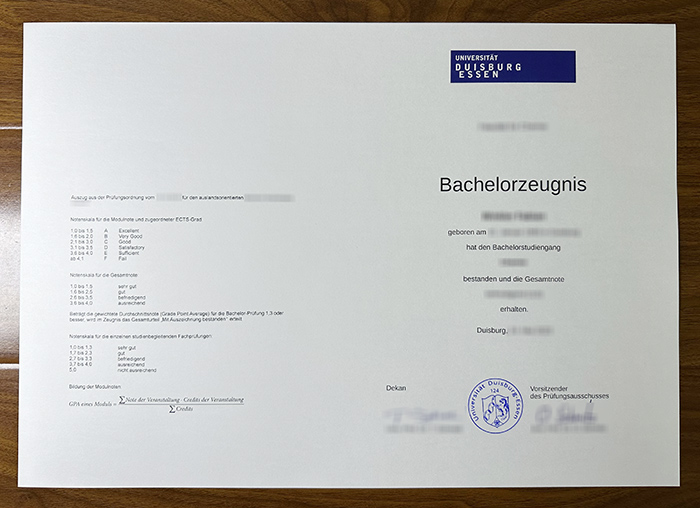
In the territory of North Rhine-Westphalia, Germany, the University of Duisburg-Essen (UDE) stands as a magnificent bridge connecting academia and industry. This young institution, formed by the merger of the University of Duisburg and the University of Essen in 2003, has rapidly risen to the ranks of top universities in Germany due to its advantageous geographical location and outstanding research capabilities. For students in science, technology, engineering, and medicine fields, UDE is not just a university but a huge industrial laboratory. Its report card is the “qualification certificate” for you to overcome technical challenges and acquire practical skills in this laboratory. Unusual method to obtain a Universität Duisburg-Essen transcript.
I. College Background: The Innovation Engine of the Ruhr Region
The University of Duisburg-Essen has a rich historical background. Its predecessor can be traced back to 1655. The merger in 2003 achieved the “1 + 1 > 2” effect: the medical strength of the Essen campus and the engineering technology advantages of the Duisburg campus complemented each other perfectly, forming a comprehensive research-oriented university with 12 colleges and over 30,000 students.
- Outstanding International Rankings and Reputation
UDE performs strongly on the international stage. In the 2019 Times Higher Education (THE) World University Rankings, the school ranks 190th globally and ranks 14th in the world for young universities, demonstrating an astonishing upward trend. In terms of discipline rankings, its medicine and engineering are both among the top 200 in the world, and in the Shanghai Ranking Academic Subjects (ARWU) of the Soft Science World University Rankings, it ranks between 301-400. - Geographical Advantage with Industrial Core
The school is located in the largest industrial area in Europe – the Ruhr Region. Here, numerous large industrial enterprises such as Opel, Mannesmann, BASF, and ThyssenKrupp (which manufactured the Shanghai Maglev Train) converge. This unique environment of “the university in the factory” naturally gives UDE’s research projects a strong application orientation. The school collaborates closely with the Fraunhofer-Gesellschaft’s Institute for Microelectronic Circuits and Systems Technology (IMS) to provide students with unparalleled internship and research platforms.
II. In-depth Analysis of the Report Card: Understanding the “Practical” Standards of German Industry
The value of the UDE report card stems from its rigorous academic standards and precise alignment with industrial needs. This is not just a score record but a detailed “qualification certificate”.
- Scoring System: 1.0 to 5.0 “German Standard”
Similar to the Technical University of Berlin, UDE also adopts the German standard scoring system, which strictly defines the academic abilities of applicants:
1.0 – 1.5 (Sehr Gut): Excellent. It represents a profound understanding in a certain field (such as industrial engineering, nanotechnology), which is a prerequisite for entering the core R&D departments of giants like ThyssenKrupp and BASF.
1.6 – 2.5 (Gut): Good. This is the score range for most UDE top students, representing a solid professional skill set and the ability to solve complex engineering problems.
2.6 – 3.5 (Befriedigend): Satisfactory. It means having mastered the necessary knowledge and meeting the graduation requirements.
4.0 (Ausreichend): Pass. This is the minimum passing standard for courses.
5.0 (Ungenügend): Fail. It results in no credits and significantly lowers the overall average score.
- Cumulative Average Score (Durchschnittsnote)
This is the core data on the report card. In Germany, achieving an average score of 2.5 or above is already a remarkable achievement. If you can maintain an average score within 2.0, it indicates that you possess extremely high academic potential. For applications to doctoral programs or entry into top companies, an average score of 2.5 or below is usually a hard requirement. - Modularization and Interdisciplinary Records
UDE places great emphasis on interdisciplinary research. Its academic transcripts meticulously record the credits (ECTS) and grades of each module.
Interdisciplinary clusters: The main research fields of the university consist of four interdisciplinary research clusters. The transcripts will reflect your study in these clusters (such as “Nanoscience” and “Urban Systems”), demonstrating your multi-dimensional knowledge perspective.
Practical orientation: Since many research activities are conducted in collaboration with enterprises, high scores on the transcripts often indicate that you not only understand the theory but have also participated in practical project development. How fast does to get a Universität Duisburg-Essen transcript online?
III. The Practical Application and Value of Academic Transcripts
- “Direct Access” to Industry
The University of Duisburg-Essen has close cooperation with German industrial giants such as Siemens, ThyssenKrupp, and BASF. Many research projects are directly funded by these companies, and students have the opportunity to participate in the company’s R&D projects during their studies. When enterprise HR reviews resumes, they will pay particular attention to the core professional course grades and project practice records on the transcripts. A high-scoring transcript from UDE directly proves that the holder has the ability to solve practical engineering problems. - “Jump Board” for Global Higher Education
With its top position in engineering and medicine, UDE’s transcripts have high recognition when applying to top graduate schools in the United States, the United Kingdom, and other countries. Its credits are widely recognized within Europe and globally. - Advantage for Returning to China
The University of Duisburg-Essen is recognized by the Chinese Ministry of Education and maintains long-term research partnerships with Chinese prestigious universities such as Tsinghua University, Fudan University, and Huazhong University of Science and Technology. After returning to China, its diploma can be certified by the China Education and Research Center for Foreign Students. Due to its top position in engineering, UDE graduates have significant advantages when returning to China to teach in universities, join research institutes, or join large state-owned enterprises or foreign companies.