In the diverse higher education landscape of Berlin, the capital of Germany, there is one university that stands out for its extremely high cost-effectiveness, close integration of industry, academia and research, as well as its “economic engineer” training model – Hochschule für Technik und Wirtschaft Berlin (HTW Berlin). As one of the largest applied technology universities in Germany, HTW Berlin is not a traditional comprehensive research university; rather, it is more like a bridge connecting academia and industry. For Chinese students who aspire to study in the German capital and pursue a “technology + management” dual background, HTW Berlin not only represents practical German education, but also its diploma is a hard currency for accessing Germany’s high-end manufacturing, technology industries, and management positions. Unexpected methods to get a HTW Berlin diploma in Germany.
I. Historical Evolution and School Positioning: From the Heart of Berlin Industry to a Modern Applied Science University
The history of HTW Berlin can be traced back to 1971, when Berlin merged several independent engineering colleges, economic colleges, and design colleges to form the Hochschule für Technik und Wirtschaft Berlin. The development history of the school is a microcosm of Berlin’s industrial and technological development.
Today, HTW Berlin has approximately 14,000 students, with about 28% being international students. It has an extremely high degree of internationalization. The school is divided into two campuses: the campus located on Treibtreustraße in the center of Berlin mainly houses economics, law, and media-related majors; while the main campus located on Wilhelminenhofstraße in the southeast of Berlin is the main base for engineering, computer science, and design majors. The Wilhelminenhofstraße campus was once an industrial site of AEG (German General Electric), and this modern campus, transformed from an old factory, perfectly aligns with HTW’s “from industry to industry” educational gene.
II. Teaching Philosophy and Disciplinary Characteristics: The Perfect Marriage of Technology and Economy
The core philosophy of HTW Berlin is “application-oriented”. Unlike comprehensive universities that emphasize theoretical research, HTW’s teaching model is highly focused on solving practical problems and interdisciplinary integration.
- Signature Majors: The Cross-Combination of Engineering and Economy
HTW’s most renowned feature lies in its “engineering + economy” interdisciplinary professional setup. In the era of Industry 4.0, a single talent who only understands technology or only understands management is no longer able to meet market demands. And HTW’s training precisely meets the needs of enterprises – “technical managers”. Its signature majors include Industrial Engineering (Wirtschaftsingenieurwesen), International Technology and Business Management, Computer Science, Renewable Energy Engineering, and Cultural Heritage Protection, etc. Especially in the field of Industrial Engineering, HTW’s graduates, due to their combination of engineers’ logical thinking and business students’ cost awareness, are highly competitive in the German job market. - Mandatory Internship and Dual System Education
At HTW, internship is not an elective course but a compulsory one. Almost all undergraduate and master’s programs require students to complete at least one semester of enterprise internship (Praxissemester). The school maintains close cooperation with companies such as Siemens, BMW, Bosch, and numerous Berlin start-up technology enterprises. Additionally, HTW offers numerous “dual system learning” (Duales Studium) opportunities. Students can work and receive a salary in an enterprise while studying at the university, graduating with both a degree and rich work experience, truly achieving a “zero transition period” employment. - Artistic Atmosphere of Media and Design
In addition to its advanced engineering technology, the Media and Information Design program at HTW is also highly respected in Germany. The school has advanced media studios and laboratories, and the courses follow the development trends of digital media, cultivating a large number of media talents who are active in Berlin, the creative center of Europe. How fast does to obtain a HTW Berlin diploma?
III. The Value of HTW Berlin Diploma and Analysis of Transcript
For Chinese students, the HTW diploma is not only an academic certificate, but also a certification of “German application ability”.
- Official Certification and Legal Effect
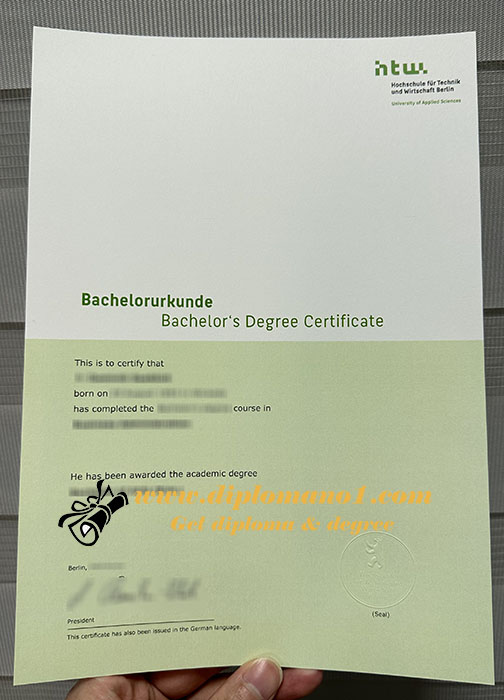
HTW Berlin is a public university in Germany, fully funded by the German government, and fully recognized by the Chinese Ministry of Education. Students who graduate will obtain a degree (Bachelor of Engineering/Arts/Science, Master of Engineering/Arts/Science) that can be processed into the “Overseas Academic Degree Certification” by the Overseas Education Service Center of the Chinese Ministry of Education. This means that the HTW diploma is unobstructed for domestic civil service recruitment, recruitment for government positions, household registration, and entry into state-owned enterprises. - Transcript: Rigorous Academic Record
The HTW transcript (Transcript of Records) is a concentrated reflection of the rigorous academic atmosphere in Germany. It details the academic trajectory of the student.
Credit System (ECTS): The transcript clearly lists the ECTS credits for each course. Usually, one course is 5-6 credits, and a bachelor’s degree requires a total of 210 ECTS, while a master’s degree requires 90-120 ECTS.
German Scoring System: Germany uses a 1.0 to 5.0 scoring system, with 1.0 being a perfect score (excellent), and 4.0 being passable.
1.0 – 1.5: Excellent (Sehr Gut)
1.6 – 2.5: Good (Gut)
2.6 – 3.5: Satisfactory (Befriedigend)
3.6 – 4.0: Passable (Ausreichend)
5.0: Fail (Nicht bestanden)
Exam Form: The transcript will detail the examination form, such as written test (Klausur), oral test (mündliche Prüfung), or course paper (Hausarbeit). German professors are known for being “picky in giving grades”, and being able to obtain a score of 2.5 (good) or above at HTW is sufficient to prove that the student’s academic strength is extremely solid.
- Workplace Recognition: “Practical” in Industry
In the German job market, the FH diploma has the same legal effect as the comprehensive university (Uni/TU) diploma, but in the field of engineering application, FH graduates are often more favored by enterprises. Because enterprises generally believe that students from HTW have strong hands-on skills, can adapt quickly, and do not require excessive onboarding training. Many HTW graduates are hired during their internship and become regular employees upon graduation. - Academic Pathways
With an undergraduate degree from HTW, students can apply for a master’s degree at comprehensive universities (such as TU Berlin, Technical University of Munich) in Germany. Although they may need to take some supplementary theoretical courses, this provides a flexible path for those who wish to continue their studies after obtaining practical skills.