In the higher education landscape of Berlin, the Hochschule für Technik und Wirtschaft Berlin (HTW Berlin) stands out as a brilliant gem. As one of the largest applied technology universities in Germany, HTW Berlin is renowned for its distinct practice-oriented approach, the interdisciplinary “technology + economy” training model, and an extremely high graduate employment rate. It has become an ideal choice for countless students who aspire to study in Germany. For Chinese students, HTW Berlin not only offers solid German engineering and business education but also its official Transcript of Records, which is an authoritative witness to the quality of this education and a core academic credential for entering the German job market or pursuing further studies. The easiest way to get a HTW Berlin transcript.
I. Overview of the Institution: The Largest Applied Technology University in Berlin
HTW Berlin has a history dating back to 1971, formed by the merger of several engineering, economic, and art schools in Berlin. After half a century of development, the university now has over 14,000 registered students, with international students accounting for nearly 30%. It creates a diverse and inclusive campus atmosphere. The university is divided into two campuses: the main campus at Wilhelminenhofstraße, which was formerly the turbine factory of AEG, has a unique charm of industrial heritage, mainly offering engineering, computer science, and design-related majors; while the Treskowallee campus is adjacent to a beautiful park, mainly covering economics, law, and media-related majors.
As a public applied technology university (Fachhochschule), HTW Berlin has a distinct positioning from comprehensive research universities like TU Berlin. HTW does not pursue a pure theoretical academic ivory tower but focuses on “application”. The teaching syllabus is jointly developed by professors and industry experts to ensure that the content taught by professors closely aligns with market demands. This pragmatic educational policy has enabled HTW to establish a high reputation in areas such as “Industry 4.0”, renewable energy, data science, and cultural heritage protection.
II. Academic Characteristics: The Deep Integration of Theory and Practice
The core competitiveness of HTW Berlin lies in its “dual system” gene and mandatory internship system. Here, learning is never just theoretical talk. Most undergraduate programs include a complete internship semester (Praxissemester), and students must leave the campus and work in enterprises for at least 20 weeks. Leveraging Berlin’s status as a European entrepreneurship hub and industrial powerhouse, HTW maintains close cooperation with companies like Siemens, BMW, SAP, and countless innovative startups.
In addition, HTW’s curriculum is highly modularized. Taking engineering or economic majors as an example, students not only need to learn professional knowledge but also must master soft skills such as project management and cross-cultural communication. This “T-shaped talent” training model enables HTW graduates to possess both the rigorous logic of engineers and the macroscopic vision of managers, making them highly competitive in the job market. Unexpected methods to get a HTW Berlin diploma in Germany.
III. In-depth Analysis of the Transcript of Records at HTW Berlin for International Students
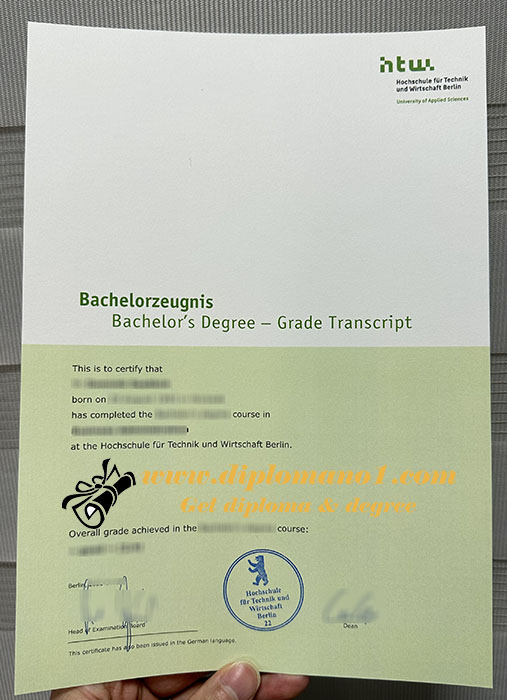
For international students, the transcript is not just a record of grades but also a legal proof of academic ability. The transcript of HTW Berlin strictly follows the European Credit Transfer System (ECTS) and German higher education standards, and its value is reflected in every detail.
- Strict Implementation of the European Credit Transfer System (ECTS)
On the transcript of HTW, each course will be marked with the corresponding ECTS credits. This is the common currency of the European Higher Education Area, ensuring the cross-border mobility of academic qualifications.
Undergraduate stage: Usually, the total credits amount to 210 ECTS (7 semesters) or 180 ECTS (6 semesters).
Postgraduate stage: Usually, it is 90 or 120 ECTS (3-4 semesters).
Credit value significance: 1 ECTS usually corresponds to 25-30 hours of learning workload (including classes, self-study, and exam preparation). Therefore, a 6-credit course means that students need to invest approximately 150-180 hours of effective study time. This quantitative standard enables employers and admissions officers to intuitively assess the academic load of students.
- Germany’s unique grading system (Notenspiegel)
Unlike the Chinese percentage system, the HTW transcript adopts the traditional German grading system of 1.0 to 5.0. The lower the score, the better the performance. This is where Chinese students are most likely to have misunderstandings and requires special interpretation:
1.0 – 1.5 (Sehr Gut / Extremely Excellent): Represents outstanding performance, usually only a very small number of top students can obtain.
1.6 – 2.5 (Gut / Good): Represents significantly above average performance, is the “golden threshold” for applying to top master’s programs or large companies.
2.6 – 3.5 (Befriedigend / Satisfactory): Represents reaching the average level, in line with the normal distribution of German university students.
3.6 – 4.0 (Ausreichend / Passing): Represents barely meeting the minimum requirements.
5.0 (Nicht bestanden / Failed): Represents not passing the exam.
At HTW, professors are known for their “rigorous grading”, and the failure rate (especially in basic courses such as mathematics and statistics) is not low. Therefore, a grade sheet with an average of around 2.5 often has a practical difficulty and value higher than the 3.0-3.5 grades in other countries.
- Detailed annotation of examination forms
The HTW transcript will list in detail the assessment methods for each course, reflecting the dimensions of a student’s ability:
Klausur (written test): Usually lasts 90-120 minutes, assessing theoretical mastery and calculation ability.
Mündliche Prüfung (oral examination): Students need to face the professor for an oral defense, assessing response ability and depth of knowledge.
Projektarbeit / Hausarbeit (project/thesis): Assessing independent research, teamwork, and academic writing ability.
Präsentation (presentation): Assessing presentation skills and logical construction.
This diverse assessment record showcases a three-dimensional and comprehensive image of a student to the outside world, rather than just a “question-doer”.
- Legal validity and usage of the transcript
As a public university in Germany, the HTW Berlin’s transcript has national legal validity.
Return-to-China certification: Along with the degree certificate, this transcript is a necessary material for the China Education and Research Center for International Students to conduct academic qualification certification. After certification, it can enjoy policies such as student settlement and tax-free car purchase.
Applying for a doctoral or master’s degree: If a student plans to apply from HTW to a comprehensive university (such as the University of Munich, Humboldt University of Berlin) for a master’s or doctoral program, this detailed list of course modules and study hours is the sole basis for the other party to assess academic compatibility.
Job application stepping stone: In Germany, HR usually requires an attached transcript (Zeugnis). A transcript showing multiple high-score internship experiences and high scores in core courses is the key to obtaining an interview opportunity.