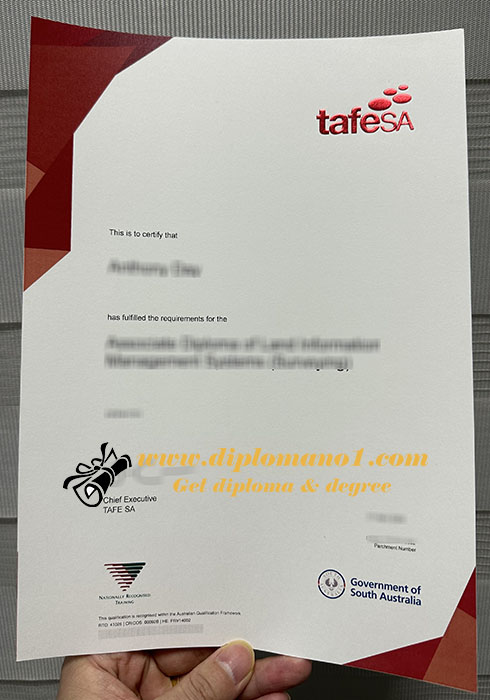
In Australia’s vast and sophisticated education system, while the “Group of Eight” universities represent the ivory towers of academic research, TAFE (Technical and Further Education) stands as the practical stronghold powering the nation’s economy. As a government-led public vocational education provider in South Australia, TAFE SA is not only the core provider of vocational training in the state but also a golden stepping stone for countless international students aiming to enter Australia’s high-paying blue-collar workforce and pursue skilled migration. For learners seeking to acquire in-demand skills at a high cost-effectiveness and quickly integrate into the Australian job market, TAFE SA and its qualifications—Certificates—are undoubtedly the “golden key” unlocking opportunities in South Australia. How does a TAFE SA certificate look like online?
I. Institutional Origins: The National Team of Vocational Education in South Australia
TAFE SA is a publicly funded educational network established and supported by the South Australian government, with a highly practical mission: to supply the local labor market with ready-to-use technical talent. Unlike universities that emphasize theoretical research, TAFE SA’s curriculum development involves close collaboration with industry experts, emphasizing a teaching model of “70% practice + 30% theory.” This means every welding technique, cooking method, or nursing procedure taught in class follows current industry standards used by real employers.
With campuses spread across metropolitan Adelaide and remote areas such as Bentley and Joondalup, TAFE SA ensures its educational resources directly reach frontline employment markets. For international students, TAFE SA offers not only significantly lower tuition fees—approximately half those of a university undergraduate program—but also qualifications accredited under the Australian Qualifications Framework (AQF), recognized by China’s Ministry of Education and eligible for official overseas study certification upon return.
II. TAFE SA Certificate: A Step-by-Step Path from Beginner to Expert
TAFE SA’s qualification system is not a single-level certificate but a clearly structured progression of skill development. International students most commonly engage with bundled programs ranging from Certificate to Diploma levels. These certificates serve not only as proof of education but are also critical for professional assessment and immigration points.
- Foundation and Advancement: Certificate III & IV
These form the foundation of vocational skills. Take South Australia’s most popular culinary course as an example: students typically begin with the Certificate III in Commercial Cookery, mastering fundamental skills such as food preparation and basic cooking techniques. They then progress to either the Certificate IV in Commercial Cookery or the Certificate IV in Kitchen Management, where they learn menu design, cost control, and staff management. These two stages usually take 1–1.5 years and are essential prerequisites for becoming a registered chef in Australia. - Management and Advanced Study: Diploma
After completing the certificate level, many students advance to the Diploma of Hospitality Management. At this stage, learning shifts beyond hands-on operations to focus on business operations, strategic planning, and leadership. For students aspiring to open their own restaurant or advance to the position of executive chef in the future, a Diploma is an essential academic credential. - Popular Program Combinations
Beyond hospitality, TAFE SA offers similar advanced courses in fields such as automotive repair, construction, and nursing. For example, in automotive technology, students begin with fundamental mechanical repairs and progress to diagnosing hybrid vehicles; in nursing, programs cover high-demand areas like elderly care and personal care. Why so many people want to get a TAFE SA certificate of Australia?
III. Admission Requirements and Duration: A Practical Choice with Accessible Entry and Rigorous Standards
TAFE SA’s admission criteria are relatively accessible, though by no means “no threshold” (zero threshold).
Academic Requirements: Applicants typically need to have completed Grade 10 or 11 in China, or be a high school graduate. Academic background determines the starting level—students may enter directly into Certificate IV or Diploma programs.
Language Requirements: Most courses require an overall IELTS score of 5.5, with no band below 5.0. However, note that registration-based professions such as nursing and early childhood education demand higher standards, usually requiring an IELTS score of 7 in all four bands or equivalent.
Age and Duration: International students must be at least 18 years old on the course start date. Popular skilled migration-focused courses—such as chef and automotive technician—are typically two years long, meeting Australia’s skilled migration requirement for two years of study and qualifying graduates for the 485 Graduate Temporary Visa.
IV. Certificate Value: A “Hard Currency” for South Australian Immigration and Employment
The value of a TAFE SA Certificate ultimately lies in its dual benefits for employment and immigration.
- Addressing the “Skills Shortage” Challenge
South Australia has long faced labor shortages, particularly in healthcare, building trades (electricians, carpenters), and hospitality services. TAFE SA graduates often secure job offers even before completing their studies due to their hands-on training. For instance, the aging population in South Australia has sharply increased demand for aged care support workers, while the recovery of tourism has made Adelaide’s hotel industry eager for skilled staff. - A “Green Channel” in Immigration Policy
Many TAFE SA-eligible occupations—including chefs, automotive technicians, and electricians—are consistently listed on Australia’s skilled migration occupation lists. After completing a two-year TAFE SA program, graduates can apply for work visas to gain practical experience and then undergo professional assessment (e.g., TRA assessment for chefs) to qualify for state-nominated 190 visas or 491 regional skilled migration visas. As a relatively sparsely populated state, South Australia offers more lenient immigration policies compared to Sydney and Melbourne, further enhancing the immigration value of TAFE SA qualifications. - A “Rampway” for Further Studies
TAFE SA is not the end of the educational journey. Its Diploma programs have credit recognition agreements with universities such as the University of Adelaide and the University of South Australia. Students who complete a TAFE course can apply for “Diploma-to-Bachelor” pathways, receiving credit toward their first year of undergraduate study, thereby reducing both time and financial costs to earn a bachelor’s degree.