On the sunny coast of southeastern Spain, the Universidad de Alicante (UA) is like an academic gem set on the shores of the Mediterranean Sea. As one of the top “internationalized” and “employability” public universities in Spain, UA is not only renowned for its modern campus and outstanding research capabilities, but also for its rigorous academic assessment system. For international students and job seekers, the transcript of the University of Alicante is not just a record of scores; it is a detailed academic file that conforms to the standards of the European Higher Education Area (EHEA), and is a “hard currency” for entering the European job market or top research institutions. Why so many people want to get a Universidad de Alicante transcript?
I. Academic Background: A Young and Dynamic Public University
The history of the University of Alicante can be traced back to the 16th century, but its modern structure was established in 1979. As a young university, UA has no historical burdens and instead demonstrates strong innovative vitality. In Spain, UA consistently ranks among the top public universities, especially in terms of “teaching quality” and “infrastructure” performance.
UA is a staunch supporter of the Bologna Process and fully implements the European Credit Transfer System (ECTS). This means that UA’s transcripts have high liquidity in the 27 EU countries and in countries and regions that have signed the agreement. Whether applying for a master’s program in Germany, France, or the UK, or for academic certification upon returning to the country, UA’s transcripts are widely recognized legal documents.
II. The “Language” of the Transcript: 10-point System and ECTS Dual Coding
Interpreting the transcript of the University of Alicante requires understanding its unique scoring system. Spanish universities typically use a 0-10 point system, combined with European grades.
- Core Scoring Criteria (0-10 Points)
On UA’s transcript, the grades for each course are usually precise to one decimal place.
9.0-10 points (Matrícula de Honor, MH): Honors matrícula. This is the highest honor, usually awarded to the top 5% of the class. This not only indicates excellent performance but also means that the tuition fee for this course can be reduced the following year (for undergraduate students).
7.0-8.9 points (Notable, NT): Outstanding. Indicates that the student has a profound understanding and excellent application ability of the course content.
6.0-6.9 points (Bien, BI): Good. Indicates a solid grasp of knowledge.
5.0-5.9 points (Suficiente, SU): Pass. Indicates meeting the basic requirements of the course.
0-4.9 points (Suspenso, SS): Fail. Means not passing and requiring retake.
- European Grades (ECTS Grades)
To facilitate international circulation, UA’s transcript often includes ECTS grades as a reference:
A: Top 10% (corresponding to MH)
B: Next 25% (corresponding to NT’s high score segment)
C: Next 30% (corresponding to NT’s low score segment and BI)
D/E: Pass range
FX/F: Fail (FX represents absence or incomplete, F represents exam failure)
This dual labeling system enables admissions officers or HR to quickly determine the relative position of the student among their peers. Where can i get a Universidad de Alicante diploma of Spain?
III. Composition of the Transcript: A Comprehensive Academic Portrait
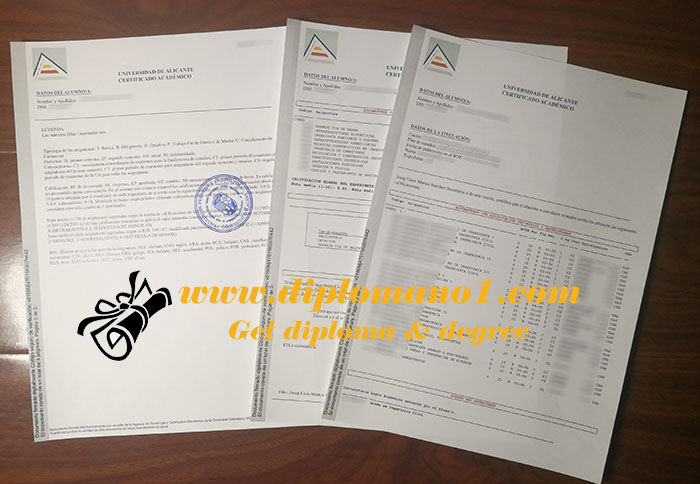
The transcript of the University of Alicante (Certificación Académica Personal) is a detailed document, typically including the following key sections:
- Course Modules and Credit Weights
The undergraduate education at UA typically lasts for 240 ECTS (4 years), while the master’s program lasts for 60-120 ECTS (1-2 years). The transcript will list the courses for each academic year in detail.
Basic Courses (Formación Básica): Usually in the first year, covering general knowledge of the discipline.
Compulsory Courses (Obligatorias): Core courses of the major, with the highest weight.
Elective Courses (Optativas): Courses chosen by students based on their interests. UA offers a wide range of elective courses, such as “Cross-Cultural Communication” and “Digital Marketing”, and the combination of elective courses on the transcript often reflects the student’s career planning direction.
- Graduation Project/Master’s Thesis (TFG/TFM)
This is the most prominent section on the transcript. UA attaches great importance to the graduation project (Trabajo de Fin de Grado/Máster). This course usually consists of 6-30 credits and the grades are listed separately. Since the TFG/TFM is usually jointly supervised by academic and enterprise/institutional mentors, the high score is evidence of the student’s ability to conduct independent research and solve practical problems. - Internship Record (Prácticas Externas)
UA is employment-oriented. The transcript will have a dedicated section to record “External Internships”. Unlike a simple “Pass/Fail”, UA’s internship grades are usually scored by the supervisors of the receiving units (such as multinational companies, hospitals, schools). A high-scoring internship record in a well-known company (such as Mercedes-Benz Alicante Factory, major tourism groups) is a significant plus on the resume. - Language and Supplementary Training
UA has a renowned Center for International Spanish Language Teaching (CIELE). The transcript will record the language courses taken by students. For international students, UA also offers “Supplementary Training” (Formación Complementaria) to help cross-disciplinary students complete their backgrounds. The passing records of these courses prove the student’s adaptability and learning potential.
IV. The Career and Academic Advancement Value of the Transcript
- “Key to Applying to Top Universities”
Due to UA’s investment in research fields (especially in chemistry, materials science, and artificial intelligence), its transcript has an extremely high reputation in the academic community. If a student obtains a “Notable” or “Honors Matricula” in quantitative courses or research methodology courses at UA, this is highly persuasive when applying to doctoral programs at G5 universities in the UK or Ivy League schools in the US. - “Passport to International Companies”
Spain is a bridge connecting Europe and Latin America. UA graduates are favored by multinational companies due to their proficiency in Spanish and English and professional achievements. HRs will focus on checking the “Professional Course Grades” and “Internship Evaluation” on the resume. For example, a student applying for a tourism management position, with a high-scoring transcript from UA’s Tourism College (under UA), directly proves their industry competence. - The Importance of the Average Score (Nota Media)
In Spain, when applying for a master’s degree or scholarship (such as FPU), the “Nota Media” is calculated. The transcript will clearly show this value (up to 10 points). Generally, a Nota Media above 7.5 is already excellent in Spanish public universities, and above 8.5 demonstrates strong competitiveness for full scholarships.